
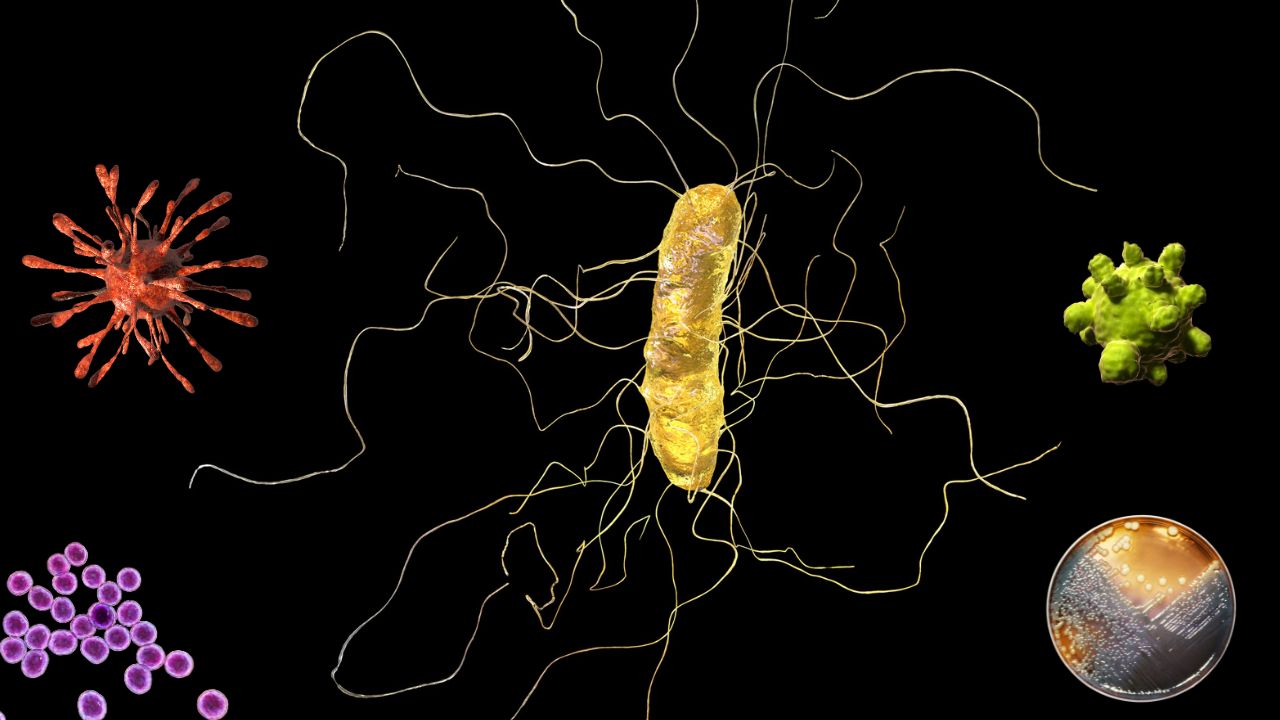
Researchers on aging, the disease that afflicts human beings and on which not all the efforts in the world are being directed (this is like having an asteroid heading towards Earth and dedicating yourself to writing down planets or seeing how it can be manufactured a better atomic bomb), seems to have long ago found that there is a clear relationship between microbes and youth. Because it is known that both bacteria and viruses are related to diseases and deterioration of our body.
At this point we know the obvious, considering we are a kind of colony of viruses and bacteria, and our body cannot live without them, but it also dies from microbes that are not beneficial. Microbes are involved in the development of all age-related diseases.
There are viruses that use anti-aging substances from the body, for example, espermidina (which we can find in Wheat Germ, among other things). As we grow we produce less spermidine, because the body needs to limit viruses, something that results in old age.
Other viruses make proteins that trick the body and are related to hormones related to aging. Others generate excess oxidative stress. Indeed, not only can microbes make us sick: they bring us old age. If we fight them, or preserve those that are beneficial, we could combat organic deterioration.
A notable experiment that verifies this was with the Killis, a fish that has very little life expectancy due to the microbes in its intestine. When they were given antibiotics they lived much longer than their usual life expectancy. Not only that. They recolonized their intestinal tract with bacteria from younger fish. And they lived much longer.
This would reflect that many intestinal bacteria help us stay young and these are the same ones that we lose with age. According to studies, those that prolonged the life of killifishes belonged mostly to species that subsist on dietary fiber. To maintain them you have to give them their food: fiber.
“In exchange, they produce a compound called butyrate that causes various beneficial health effects. Butyrate, among other things, interacts with the immune system,” the author of The Immortal Medusa tells us.
The researchers came to the conclusion that to produce at least the rejuvenation of the immune system, which after all is responsible for avoiding the infections that plague us, the key is a specific organ: the thymus. Without the thymus, with age, inflammation begins throughout the body, which sets off the immune system's alarms in vain.
It is the decline of the thymus that results in a weak immune system. Making the thymus young again is making us young again. At least, internally: it would confront viruses, bacteria, all kinds of infections that ultimately age us. It would clean up zombie cells, it would fight cancer better, even the flu that takes so many old people, could be efficiently eliminated with a young thymus.
Russian researchers put this theory to the test. And they transplanted the thymus of the young ones into old mice. And indeed, the elderly were able to face infectious diseases and live longer. It is also known that the administration of Zinc has partially regenerated mice, it seems that supplements of this metal serve this purpose. Not only in mice, he suspects that zinc supplements also serve to reduce the number of infections in older people.
Now, if we extrapolate this same thing to the preparations of the ancient alchemists, with their sprays with aerial nitros, their mineral antimonies, their nitrous Solaris pulvis, their rancid toxic mercuries, in what way do those substances that have no antibacterial effect (except stibnite with tartar in known cases) could improve the microbes that give us youth? None. No way.
It already tells us everything about such ancient preparations and in my latest book you will find a greater analysis.
Well, just as we age, these microbe colonies deteriorate. Above all, perhaps, because they do not receive the food they need for their survival, or simply because the body begins to fail. And then non-beneficial microbes prevail, and infections, even the simplest ones, bring us death.
If we want to prolong life, we must end infections. In the science fiction novel A Time for Love, by Robert A. Heinlein, the immortal mentions that one of his notable characteristics is that, from a young age, he had no infections, his teeth had no cavities, and thus, for 300 years, Before cloning his body and living longer, he had no problems whatsoever.
Article in Spanish: click here


0 Comments